Sunday, May 26, 2013

The Agony And The Ecstasy

The second half of the 1960s not only saw Godzilla continue his metamorphosis from a terrible monster into a (somewhat) heroic figure but a change of the film series itself from one that both younger and older viewers could enjoy to one meant purely as entertainment for children. It also saw the first shift away from the old triumvirate of Honda/Tsuburaya/Ifukube, as a new director would take the helm of the first two movies of the period and not only use the musical stylings of Masaru Sato (who had scored Godzilla Raids Again) but a tropical South Seas Island location for both of his Godzilla efforts. The second two would see the return of Honda in a last bid to recapture the glory years of Godzilla and a straight-up kiddie movie, respectively. Here now is

Godzilla MAYhem
Part III: The Late Sixties


Ebirah, Horror of the Deep (1966)

This is a fun movie. Director Jun Fukuda basically gives us a James Bond-style movie, with bank robbers cum anti-heroes, SPECTRE-style villains, enslaved islanders and nubile island girls – oh, along with a giant radioactive dinosaur and the title crustacean duking it out in the climax. If that doesn’t make you want to see this movie then I can’t do anything for you.


"Now is the time on Sprockets when we dance."
All you can eat.

I've always wondered what Godzilla looks like drunk....

Oh, yeah, this movie has Mothra in it -
because you can never get enough Mothra.
"In nomine Mothra, Lepidoptera Sancta, amen."
Wow, she looks pretty immaculate for someone with no access
to modern medicine or beauty products....
When it comes down to it, this is what you came to this movie to see.


Son of Godzilla (1967)

Here I have a bit of a conundrum. See, objectively I know that this one isn’t as good as the last and in fact feels really close to it superficially (island location, nubile island girl, giant bugs), and the titular spawn of the King of the Monsters makes me want to gag and throw something at my monitor… plus Godzilla himself looks really awful, with the worst Godzilla suit ever used on any of these films. But on the other hand this was the first Godzilla movie I ever saw and it’s still a sentimental favorite. Plus it’s not that bad, with good puppet work on the giant creepy-crawlies, a neat weather-experiment plot, genuine excitement, a scary giant spider (is there any other kind?) and an awesome score by Masaru Sato.


I've always wondered what Godzilla looks like stoned....

"Look, Dr. Thompson, that giant radioactive lizard looks baked."

Okay, it's ugly, but I can deal with-

KILL IT WITH FIRE!

Bugs!

This is about one frame away from turning into a domestic violence call.

Quiz time: what is more terrifying than giant bugs?


Destroy All Monsters (1968)

Godzilla fans love this one – I don’t think it’s that hot. Oh sure, it brings together all of the Toho movie monsters (thus the title) but the plot is a basic retread of Invasion of Astro-Monster (aliens control the giant monsters to take over the Earth!) with the same plot holes (*why* do the aliens need the monsters if they’re so advanced?), plus some new ones (why is Mothra confined to Monster Land? Did the Infant Islanders not want her as their goddess anymore? Where are her fairies?), but without the charm. It’s rather dull, actually, showing that Toho and Honda had basically run out of ideas by 1968. I like Ishiro Honda’s stuff but by the late Sixties he was spent creatively – he would have only one more burst of glory in the 1970s before retiring from directing (but we’ll get to that next time). This movie is watchable enough, I guess, but not spectacular – watch it to see the monster round-up but expect a minor let-down.


Okay, who's been microwaving cabbage in the break room again?

Hey, no copping a feel, buddy!

THAT'S how you destroy New York, Tri-Star!

It's the 1960s and it's not Star Trek, so all of the spaceships are
either flying saucers or rockets with butane lighters.

Poor Mothra's hanging in the back, feeling all dejected.

"Thank God.  We almost missed tonight's episode of Abarembo Shogun."

This is simultaneously the most hilarious and most awesome thing
I have ever seen in a Godzilla movie.


All Monsters Attack (1969)

This one is unfairly dumped on by Godzilla fans. What they fail to realize is that it’s a bona fide children’s film, and adults were never the target audience. Kudos to Ishiro Honda, I guess, for wanting to do something different after the previous movie, even if about half the movie is stock footage. But even that is forgivable – remember, in 1969 there was no home video and movies didn’t even come on TV that much, so the youngsters of the time period (especially those too young to have seen earlier Godzilla movies) probably relished the chance to see Godzilla’s Greatest Hits on the big screen. And the main human story, about Japanese latchkey kids and their domestic problems with their absent parents is relevant and touching, even if it gives kids a bad message in the end (impress the bullies by doing bad stuff so you can be popular!). The other interesting thing about All Monsters Attack is that it may be the only Godzilla film where Godzilla isn’t real – taking place in the “real world” as it were. In the end, it isn’t a great film or even a good one but a decent enough flick for young children… just remember to cut it some slack the next time you watch it. Even if you want to strangle that singer at the beginning.


Okay, what is it with the Japanese putting their kids in short-shorts?

...aaand, apparently Japan has Jewish people.

"So, like, who would win in a fight?  Lisa Gerrard or Elizabeth Fraser?"

Cue Ah-nold: "You are one ah-gly mathafuckah!"

Yeah, I know, kid.  If I were standing next to that I would have
that expression on my face too.

Do it again!  Do it again!

Japanese people in white-face!  Progress!


Well, that’s the end of the Sixties. Next time, things get really weird with the advent of the Seventies and the complete slide of the Godzilla film series into total bizarre, but fun garbage.

Monday, May 20, 2013

Classic Psychodrama 101

The 1960s were a time of great change for Godzilla. At the beginning of the decade he was still a frightening menace to Japan and indeed the world… by the end he had metamorphosed into a defender of the world, albeit a reluctant one. This change began in the first half of the Sixties, with a string of four films, each building on the last. Without ado let’s continue our trip through

Godzilla MAYhem 
Part II: The Early Sixties 


3. King Kong vs. Godzilla (1962)

The second castle to get trashed in a Godzilla movie - what's up with that?
This is where sings start to get a little silly (even director Ishiro Honda thought so). This is actually a rather disappointing film, for quite a few reasons. First is that the original Japanese version is not really available in the United States (where I am reviewing these from), and that it wouldn’t be optimal even if it were. For this marathon I made the decision to review the original Japanese versions of each film – not that I can speak Japanese, see, but often with the Godzilla movies some scenes were deleted and sometimes even added (as we have seen with the 1956 American version of the original) for the Americanized English dub versions, and I wanted to talk about the original products. However, because of litigious wrangling the Japanese version of King Kong vs. Godzilla is not legally available in the US and I don’t have the means to see it. All I have to go on is the American version (which was co-produced simultaneously) which is cheesy, cheesy, cheesy (and very white – “we can’t show this movie to American audiences unless it has white people in it!” – thus the white reporters and scientists in clunky UN cutaways) in addition to butchering the musical track by hacking out Akira Ifukube’s music and substituting generic fifties sci-fi schlock in its place. And the sad part is that even if the Japanese version were available legally over here it wouldn’t be in good shape – reportedly the original 35mm film stock was so badly kept that the only way that the parts exclusive to the Japanese version are available is from an old 16mm transfer, meaning an obvious drop in quality at those points in the movie while watching on DVD.

Yes, this really happens in the movie.
The saddest thing is that even if the Japanese version were available legally AND in good shape that it would probably still not be very good. This was a chance to pit the two biggest movie monsters of all time against each other in mortal combat (“finish him!”)… the first time two monsters from east and west would meet… it was the first time both monsters would be shown in color, and in widescreen… and the producers completely dropped the ball with the King Kong suit. The Kong used in this movie is unbelievably bad… you could probably go down to your local party store and rent a gorilla costume that would make a better Kong than the one used in this movie. Supposedly it was the American producer’s fault – he supplied the suit and Toho was obligated to use it, and it’s a dirty shame. This is especially so considering that the *Godzilla* suit used is great, looking really reptilian and menacing.


Japanese people in black face!  Progress!
 In the end because of this deficiency in special effects (in addition to the Kong suit being awful a lot of the blue screen work is too) and its silly plot (including some rather... outdated racial views) King Kong vs. Godzilla is a very disappointing missed opportunity… still, it’s the highest grossing Godzilla movie ever. Perhaps a remake is in order?


4. Mothra vs. Godzilla (1964)

What’s *not* disappointing is this entry into the Godzilla mythos, which ends up being the second greatest Godzilla movie ever made right behind the first and actually manages to be better in some ways. The plot is somewhat similar to the original Mothra (from 1961), except that instead of greedy businessmen kidnapping Mothra’s twin fairy priestesses for exploitation and facing the wrath of the giant wool-eating kaiju they instead kidnap Mothra’s egg for commercial use and risk the safety of all in Japan when the contents of the egg hatch. Throw a pissed-off Godzilla into the mix and you have monster movie gold!

This is the film where the Godzilla series starts taking more of a turn towards the fantastic (you know, not that radioactive dinosaurs and giant gorillas were fantastic). This film includes not only a giant lepidopteran goddess and tiny, harmony vocalizing creatures that worship it but the notion that these beings would actually help the human race after being dumped on by them. The big dramatic center of Mothra vs. Godzilla is the puny human main characters begging Mothra and the shat-upon inhabitants of nuclear-devastated Infant Island to help them against the rampaging Godzilla – and she and they agree! It’s pretty weird when the character making the big dramatic decision is a giant moth, people.

Okay, now it's just a fetish.
Everything clicks in this movie. The acting is decent all around, the villains are appropriately smug and slimy, and the visuals are great. The compositing is much better than the last film, although still a little bit blurry. The Godzilla suit used for the movie is the best ever made, and looks truly evil and menacing. The score is wonderful. If you are a Godzilla fan you already own this movie. If you are just getting into Godzilla this is one of the movies you want to start with. Even if you just like fantasy films this is one to get. Watch this movie.


5. Ghidorah, The Three Headed Monster (1964)

This film, released the same year as the last one, marks the first time Godzilla helps humanity, albeit at the very end and very reluctantly. It also marks the first multiple giant monster battle, with four kaiju taking part in the final battle. The plot is, at its core, simple. A foreign princess disappears from her plane midflight then shows up in Japan claiming to be a Venusian prophetess and foretelling doom. Meanwhile a mysterious meteorite lands in the mountains and later releases King Ghidorah, the titular tricephalic titan of terror who proceeds to lay waste to everything in its path. With the help (once again!) of the twin priestesses of Mothra (who happened to be in Japan on a Mothra PR Tour), the humans must convince Godzilla as well as Rodan to team up with the giant bug to put the hurt on Ghidorah and save the world.

"King Ghidorah is coming to kill us all.  Also, I'm English."
This is actually one of the Godzilla movies that I never saw as a kid and didn’t see until it came out on DVD a few years ago. As such I didn’t have any nostalgia for it when I sat down to watch it as an adult – but you know what, I still liked it. It’s not as good as the previous installment, but it is still a very entertaining little Japanese fantasy film. The plot about the princess/prophetess (played by Akiko Wakabayashi) is entertaining enough. The singing duo The Peanuts are back again as the twin fairies and are always a hoot. The design of Ghidorah is impressive, what with his three spastic heads, genuinely scary look and weird shrieking cry. You can actually believe that it would take a team-up of the world’s strongest monsters to beat him.

Sadly, Godzilla himself isn’t quite as good looking this time around, as Eiji Tsuburaya chose to give him bigger eyes in order to make him look friendlier as befitted his new anti-heroic role. Also, some of the fight scenes are kinda goofy, including some of the antics in the final showdown with King Ghidorah. Oh well. It’s a movie with men in rubber monster costumes hitting each other – I’m not gonna be too picky.

6. Invasion of Astro Monster (1965)

It's still better looking than Plan 9 From Outer Space.
Oy. The plot of this one is rather loose and makes little sense. Full of wacky inventors, dancing monsters, flying saucers, duplicitous aliens who look like members of the Smart Patrol, mind control, and Nick Adams, this strange film is more style than substance – you will be repeatedly wondering about plot holes large enough to fit a rocket ship through. But what style! The monster fights are once again great, the story (even if it has the aforementioned holes)is entertaining and American actor Nick Adams gives more effort than a movie like this probably deserves.

It also doesn’t hurt that he has good chemistry with co-stars Akira Takarada and Kumi Mizuno (Adams and Mizuno had worked together earlier that year in Frankenstein vs. Baragon, aka Frankenstein Conquers The World). The film also continues the slow slide into silliness for the franchise, as Godzilla is shown dancing a jig after his first fight with Ghidorah on Planet X (only when reviewing a movie like this could I type a line like that). Instead of giving you a picture of it though I’ll let you get the movie and see for yourself. Ah, who am I kidding, you’ll probably just watch it on Youtube.

Are we not men? (old joke)
Invasion of Astro Monster is a fun enough romp even if objectively it’s not as coherent as the film that preceded it. If you have kids or are a kid you will want to get it – I enjoyed it very much as a child and still do to a certain extent.


Well, there’s the four Godzilla movies of the early Sixties, aka the Golden Age of Godzilla. After this the cracks would begin to show with kid-friendlier content and the increasing heroism of the title monster chipping away at what made the series great to begin with. The movie would still be enjoyable though, but that’s a tale for next time.
Saturday, May 11, 2013

With A Purposeful Grimace And A Terrible Sound....

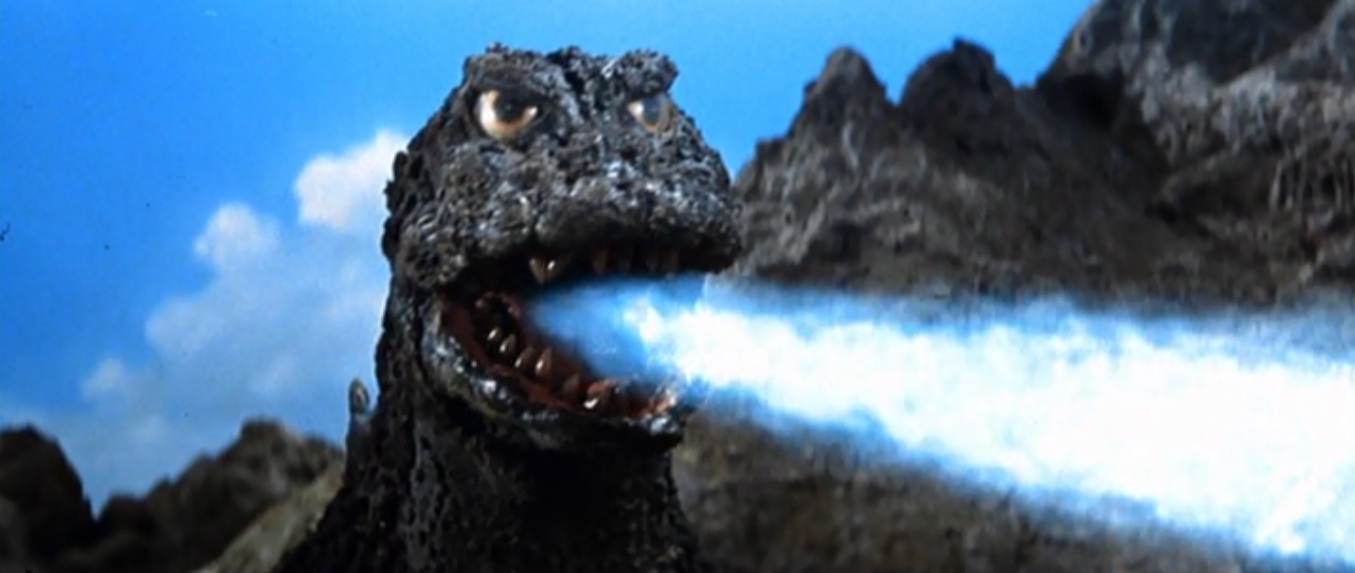
And now for the main event: all this month I will be providing a retrospective on the original series of Godzilla films (1954-1975), reviewing them and even doing a little reminiscing about their place in my childhood and doubtless the childhoods of many. For this first post we’ll be looking at the origin of the King of the Monsters and appraising his first two movies, which were both made in the same decade and filmed in black and white. So put on your hazmat suit, cower in fear and prepare for the end of humanity because here comes


Godzilla MAYhem 
Part I: The Fifties 


The story of the creation of Godzilla is pretty well known, so I won’t go into too much detail here. As well as being an obviously potent symbol of the nuclear holocausts of Hiroshima and Nagasaki, Godzilla was more directly inspired by the Lucky Dragon Incident, where in 1954 a Japanese fishing boat was exposed to radiation from an American nuclear test in the Pacific. Later that year Toho producer Tomoyuki Tanaka and director Ishiro Honda gave the nuclear threat to the human race physical form as a 50 meter tall, charcoal grey, reptilian nightmare named Gojira (or Godzilla).

1. Godzilla (1954)

The first Godzilla movie is very earnest and very grim. The titular monster is an unstoppable, rage filled, radiation spewing terror that represents the sins of humanity made flesh. Unlike later films which almost revel in the destruction of miniature sets and delight in fantastical monster battles, here everything is taken seriously – you are not meant to cheer Godzilla as he destroys Tokyo, you are meant to emphasize with the suffering of the victims. And yet, when he meets his end at the conclusion of the film one almost feels pity for the monster, who is not truly *evil*. Human beings are just doing what they need to in order to survive, just as Godzilla did what he naturally did – destroy.

Godzilla is a triumph for director Ishiro Honda. He lets the mystery and tension build through the first part of the film until the reveal of the monster, then lets the tension build again until the attack on Tokyo. Then he puts you right into the middle of it, letting you experience the horror firsthand. Composer Akira Ifukube gives cinema one of its finest scores – emotional, savage and memorable. This is one of the few instances where the orchestra being non polished is a good thing… the rough strings slicing through the opening theme, for instance, really lets you know what is going to come ahead. Takashi Shimura (who also starred in Seven Samurai that same year) gives a noble performance as a paleontologist who wants to study Godzilla but realizes in the end that he must be destroyed. The main protagonist of the film though is ultimately Dr. Serizawa, as played by Akihiko Hirata. It is he who must make the most painful decision of the movie – help to destroy Godzilla with his new Oxygen Destroyer device and risk unleashing a worse weapon on the world or declining to let his work be used as a weapon and watch Godzilla burn Japan. David Gerrold in his book The World of Star Trek pointed out that the key theme to any real drama is not “hero in danger” but “hero has a decision to make.” The decision that Dr. Serizawa makes at the end of the movie is saddening but logical. This would be the first and last Godzilla film to have any such real dramatic conflict (kind of – more on that in the next post).

Are there any flaws with Godzilla? Of course (no movie is perfect). There are occasional lapses in the special effects, great as they are (by the visionary Eiji Tsuburaya). Also, the love triangle between Serizawa, his fiancĂ©e Emiko and her lover is rather melodramatic… and boy does Emiko cry. A lot. As in, the drop of a hat. Oh well. It’s a great film anyway, a classic that you should see at some point in your life.

1.5 Godzilla, King of the Monsters (1956)

In 1956 Godzilla was released in the United States as Godzilla, King of the Monsters. Adding footage of American actor Raymond Burr and snipping any mention of Hiroshima and Nagasaki, the US version is still watchable but not quite as potent. It’s actually kind of cheesy watching Burr as reporter Steve Martin (hah!) narrate Godzilla’s rampage through Tokyo, fretfully wiping his brow – I even remember thinking so as a kid when I saw it for the first time. Not bad, but in this age of DVD and Blu-Ray you can now see the original, so just stick with the original.

2. Godzilla Raids Again (1955)

The sequel is nowhere near as good. Directed by Motoyoshi Oda and scored by Masaru Sato (Kurosawa’s composer of choice from 1955 to 1965), Godzilla Raids Again ends up being almost a rehash of the first, which isn’t surprising considering it was released only a year after the first – presumably to cash in while the original was still in the minds of the public. Once again, there is a love triangle. Once again Godzilla rampages and destroys (duh). Once again a character will have to make the ultimate sacrifice in order to stop him. The only things different this time around are a) Godzilla trashes Osaka and not Tokyo (which would see it’s fair share of monster mayhem in the years to come, so don’t breathe easy yet, Tokyo), and b) he’s not alone.


Yes, this is the first Godzilla movie, and by extension the first Japanese monster movie to have a giant monster battle. Godzilla’s first of many opponents is Anguirus, a spiny ankylosaur-looking thing who will ironically enough become an ally later on in the 60s and 70s. Their fight is an interesting one: instead of the camera being over-cranked in order to make the action slower and “weightier”, footage for the monster scenes was accidentally under-cranked, meaning that Godzilla and Anguirus’ fights have a quick, almost feral look to them. Overall, Godzilla Raids Again is worth picking up if you’re a Godzilla or kaiju fan but don’t expect anything really special…

…unless of course you want to laugh your ass off, in which case watch the American version, released as Gigantis the Fire Monster. I’m not going to go into detail about how this turkey got made (zip on over to the Wikipedia real quick) but suffice to say this is one of the worst localizations ever… with dubbing to match. Because the producers wanted the English dub to match the lip movements of the original actors, some of the dialogue in this movie is bizzare, to say the least. In addition the main character (voiced by Keye Luke) will not shut the Hell up, and narrates everything, and I mean everything (“When I got back from my scouting trip I had to take a big dump. So I went to the toilet and crapped out a big one. It was kind of fat and very long, with some interesting speckles in it. Then I….”). Add to that a whole bunch of extraneous footage was pasted in from other sources, and the effect is about what you’d expect. It’s too bad the guys at Mystery Science Theater 3000 never got their hands on this. Oh well, if you have the DVD you can make fun of it with your friends – a great way to spend your Saturday night.


Well, that’s Godzilla in the fifties: a frightening nuclear menace terrorizing a country still recovering from World War II. Next time we’ll look at the Big G as he evolves during the early sixties into a reluctant anti-hero.

Tuesday, May 7, 2013

The Motion Never Stops

Before I get to my special theme for this month which I'll post in a couple of days, I just wanted to take a quick opportunity to note the passing of Ray Harryhausen, special effects pioneer extraordinaire.

It's a shame we don't have visualists like him around anymore - I have never really liked CGI, I think that 99% of the time that computer graphics will never look as good as a real physical object... even if the computer image is excellent and the physical object is kinda cheesy.  I just don't think that we can make CG that looks real yet.  And I realize when I say this that computer programming and graphics are hard work, but I just don't think that the FX of today can stand up just because it's too *easy*... a director and an effects supervisor can just sit down at a computer and bash out what they want with none of the painstaking labor and craftsmanship that used to be put into movie visuals... by people like Mr. Harryhausen.

His movies occupy a special place in my collection.  I have always enjoyed fantasy and science fiction films (no!) and I remember watching some of Harryhausen's movies like Jason and the Argonauts whenever they would come on TV.  His fantasy movie collection also happens to be one of the oldest DVD boxsets that I own, having got it as a gift close to ten years ago now.  I have had ample to time to enjoy the fruits of his labors, again and again and again and again.

And in this age of home video thankfully everyone can.  So here's to you Mr. Ray Harryhausen.  I would say I hope you go to heaven if there is one, but I don't think they have any cool monsters there.


Tuesday, April 30, 2013

Wait For It....

Megalon says to BE PATIENT


– a very special event is being planned for next month.

Thursday, April 4, 2013

Ghost Writer In The Sky....

Roger Ebert died today.  It's kind of weird when you think about it.  Sometimes we get so used to certain people being around it's so damn... strange when they no longer inhabit our plane of existence.  I had the same feeling after James Brown died... I suddenly lived in a world without James Brown, and that seemed both bizarre and unacceptable at the same time.  But, you say, James Brown was a creator, an inventor - he basically invented funk music, he was the Godfather of Soul, he influenced whole musical genres in addition to artists with his music.  Roger Ebert was a film critic, his whole job was just to analyze what other people created and tell an audience whether he thought they should see it or not.  How can he be considered special?
Well, Roger Ebert actually worked on a couple of movies himself.  No he wasn't a director or actor but he was a (surprise) writer, writing a couple of movies for Russ Meyer in the 70s, one of which being the infamous Beyond The Valley Of The Dolls.  Both of these movies were very, very bad (but in a laughable, fun kinda way).  But the point is, Ebert *did it*.  He actually participated in filmmaking, understood the process.  When Roger Ebert criticized some movie for being bad, he would know because he wrote some bad movies himself.  This is more than most movie critics could and can do.  Nowadays your average film critic is just some hack who took writing and film courses in college and thinks that they know more than you will ever know about film just because they studied it in school.  The sad truth is that anyone who can pick up a book and read or sit still enough to watch a movie for a couple of hours can write a half-intelligent movie review.  But few can write movies reviews well and with  true knowledge of the craft, and Ebert was one of them.

Even when he was wrong.  I remember reading a negative review of his on the original 1954 Godzilla.  I was nearly foaming at the mouth and proclaiming that Ebert wouldn't know a good movie if it came up and bit him in the ass.  But you know what?  I had that reaction because his opinion *mattered*... because he wrote well.  Most other reviewers (few can actually be called true critics) don't get that kind of response out of me.  I read their shit and say, "Hmm", and forget about it a minute later, even if I find their viewpoint contentious.  Ebert made you care with his opinion, and that is rare in modern film criticism, where most writers are just trying to impress you with their writing "talent."

I actually have no pretenses to Mr. Ebert's job.  I am not a film critic.  I am simply some dude on the internet ejaculating forth his opinions because it gives him an excuse to write, to hone his composition skills.  If someone comes along and engages me on something I wrote, that's great but it's not my purpose.  The point to all this is, Roger Ebert was a true film critic and I am not, but I'm writing this tribute anyway because... I want to.  It's not some gushing from one professional to another but some honest thoughts from someone who enjoyed reading his stuff.  Even if no one else sees this I want to write how much his film reviews and writing in general meant to me.  Even if he was dead wrong sometimes.

And that was the fun part.

Monday, April 1, 2013

Clarification

This is just a short notice that as of today The Pharonic Fantasy Theatre will now have a ratings system.  Why now instead of from the beginning?  Well, in the beginning I figured that I wanted people to actually read my reviews in order to ascertain my attitude towards a particular movie or TV show instead of taking the easy shortcut and just looking at a number at the bottom of the screen, but after hundreds of emails and comments from my die-hard fanbase I have realized that I want to make everyone's life easier and quicker and get readers onto and off of my little corner of the internet just a little faster.  Besides, all of the malcontents are right - It *is* too hard to read through paragraph after paragraph of review just to find out if you want to see a movie or not.  That's too much work.  Work is hard.  Quality must be quantified.

So, without further ado, I give you the New Pharonic Fantasy Theatre Patented Movie And TV Show Ratings System™.

I will rate all pieces of media on a scale of 1 to 77, except Japanese pornographic anime, which is rated 1 to 69, and anything produced by Michael Bay, which will be rated from -500 to 2.  After the number rating I will have a content marker, to warn parents and other sensitive souls about any icky content, and then another number saying how many times this ickyness occurs in the said media, followed by a division or multiplication sign designating what time of day you should watch this particular item.   Disturbing Content markers are as follows:

V for Violence
N for Nudity
S for Sex
D for Drugs
T for graphic Torture
AS for Adult Situations
A for any Annoying sidekick character that makes you throw something at the television
P for any Prison scenes
R for Rape or sexual assault
I for any graphic displays of Illness or disease
L for Language
F for any Foreign Content
OO for gratuitous bOObs
LS for Low Sodium content
FX for any bad effects
W for William Shatner

Well, there you go.  From now on, all of my reviews will use this simple, easy-to-understand system to help you the reader figure out whether you want to see something instead of slogging through all the crap I write.


Next Week:  pictures from my oiled-up orgy with the German ladies' all-nude horseshoe team.